A New York Town Rallies to Defend Its Students’ Education Rights

The Campaign was inspired by a strong example of education-focused civic engagement set by one New York school district’s officials and community members earlier this month. On November 6, in Ossining, NY, we participated in a panel discussion and community forum that drew close to 200 concerned parents, students, and other community members as well as education experts from around the state. The event, entitled “Stop Underfunding Ossining Schools: Unfreeze NYS Foundation Aid,” was organized by the office of Superintendent Raymond Sanchez in collaboration with Ossining’s school board and Citizens’ Budget Advisory Committee under the leadership of Alita McCoy Zuber, Assistant Superintendent for Business.

Between 2007-08 and 2012-13, Ossining experienced a 17% increase in student enrollment, and the number of children living in poverty grew 27%. However, the district has not received additional per pupil funding from the state that would allow it to meet the educational needs of its new students and maintain the quality instructional program that existing students had been receiving. [Click here to view the related presentation.] Because, based on the state’s own funding formula, New York State has underfunded Ossining schools to the tune of $35.5 million over four yearsthe school district was forced to cut more than 100 staff positions and slash services for students.

A school board resolution calling upon the state government to fulfill its constitutional obligation to provide the resources to allow Ossining to give all its students a sound basic education was proposed and unanimously passed by the school board. Applause from panelists, community members, and an impressively engaged group of high school students signaled the urgency of the matter.

CEE distributed copies of our Safeguarding Sound Basic Education research brief and, during the panel discussion, encouraged attendees to consult our Essential Resources document, one of the most powerful tools available to New Yorkers looking to ensure that students receive, at the very least, the full complement of educational opportunities guaranteed by state law.

Throughout New York State, community by community, we all must sound the alarm and come together to assess our challenges, analyze our options, and work collectively to advocate for our children’s educational rights. If students in your school district have been harmed by cuts in state education aid and you are planning to host a similar community forum to mobilize your families and other neighbors, please email us at equity@tc.columbia.edu.

How Much Will It Cost to Make Pre-K Truly Universal in New York State?

The research is clear: High-quality full-day pre-K can significantly improve children’s success in school and beyond, producing major savings for the public school system and the broader community as well. The short-term savings for schools accrues from reduced need for costly remedial services, grade retention, and special education. In the long run, the return on investment is much higher, netting benefits for children, families, the schools, and taxpayers. That’s because children who participate in these programs are more likely to be reading on grade level by third grade, graduate high school and go on to college, and become productive tax-paying citizens. Economists put the return as $7 for every $1 invested, thanks to reduced costs for social services and criminal justice. Pre-K graduates are also healthier. Nobel laureate James Heckman argues there is no better investment the U.S. can make in developing our full human potential.

CEE, in partnership with the Center for Children’s Initiatives, recognizes these enormous gains for New Yorkers in our new proposal, Making Pre-K Truly Universal in New York. This eight-year roadmap starts with four-year olds in high-need districts and expands to provide pre-K access to all three year olds and four year olds statewide by the eighth year.

Frank Mauro, the executive director of the Fiscal Policy Institute, an independent, nonpartisan, nonprofit research organization based in Albany, has conducted a careful cost analysis of our plan, which builds on the current state investment of $410 million in pre-K. In the first year, the plan would invest an additional $225 million to provide full-day service to approximately 20,000 four year olds in high-need districts. In the second year, the state would invest $476 million; this would cover about 40,000 four year olds in high-need districts.

This new investment is made in addition to necessary increases in K-12 funding, and assumes the state will pay the full costs of expanding pre-K in the first two years—and until districts have full funding levels necessary to meet Campaign for Fiscal Equity (CFE) v. State sound basic education requirements. The plan envisions local districts picking up an appropriate share of the costs, depending on their local wealth and levels of need, starting in the third year, if the CFE standards are met.

The chart below offers a guide to both the implementation plan and the costs. By year 8, the total cost to the state and local school districts will be approximate $2.4 billion—an increase in overall education spending of about 4%. That’s a bargain, given the incredible benefits that will accrue to children, schools, families, and taxpayers.

State Cost in 2013-14 Dollars in Excess of 2013-14 Universal Pre-K Allocations


Phase-in Year Children Accommodated                                     Total New Costs to the State
1 All four year olds in first third of high-need districts $225,551,405
2 All four year olds in two-thirds of high-need districts 476,102,810
3 All four year olds in high-need districts 569,070,535
4 All four year olds in high-need
districts and half of remaining districts
313,323,746*
5 All four year olds statewide 361,166,058
6 All four year olds, plus three year olds in first half of high-need districts 628,267,316
7 All four year olds, plus three year olds in high-need districts 895,368,574
8 All three and four year olds statewide 1,050,342,365

* Local districts start paying a local share of pre-K costs according to K-12 “state sharing formula.”

When truly universal full-day pre-K for all four year olds in every district in the state is achieved in year 5, the cost to localities (much of which will be paid by more affluent districts) will be $674 million. When the program is fully implemented, providing access to all three and four year olds, the costs to localities will be $1.4 billion (much of which will be paid by the more affluent school districts).

(Note that we provide these long-term cost calculations for general illustrative and discussion purposes; we recommend that New York conduct a statewide analysis of the actual costs of the pre-K program beginning in year 1 and adjust expenditures to actual costs in year 3.)

Cost Offsets

Economist Clive Belfield estimates that, within a few years of implementation, 40-60% of pre-K expenditures will be offset by savings to the K-12 education system. Long-term economic benefits to society (in added income, tax revenues, lower crime rates, lower health costs, and the like) are much greater (see the summary of research in our report, pp. 37-40).

Furthermore, if President Obama’s pre-K initiative is adopted, 25-95% of these costs will be reimbursed by the federal government.

How These Costs Were Calculated

For our base per-pupil amounts, we used the current rates for preschool programs in the high-need Abbott districts in New Jersey—effective, high quality programs for which detailed cost data are available. The rates for New York City were set to equal those for the Abbott districts in Hudson County, NJ, which are close to NYC in terms of proportion of students from low-income households, cost of living, and so on. Those rates are (a) for full-day public school programs: $13,224; (b) for full-day community provider programs: $14,865; and (c) to supplement federal funds for Head Start programs: $8,213. The base per-pupil amounts for other New York State districts reflect a combination of each district’s pupil need index and its regional cost index relative to the New York City figures (e.g., for Rochester, the rates would be $14,069, $15,815, and $8,739, respectively and for Williamsville (Erie Co.), the rates would be $7,889, $8,868, and $4,900, respectively).

These rates include small class sizes, master teachers, family workers, social workers, outreach programs, parent workshops, medical supplies and screenings, and preschool intervention and referral teams.

On same day as we released our roadmap, the Citizens Budget Commission (CBC) also released a report on the challenge of making pre-K universal in New York. CBC calculates somewhat higher total incremental costs for the program than we do, citing a range of costs from $3 billion for a scenario that, like our analysis, is based on the cost of the NJ Abbott programs to $4.2 billion, based on a second scenario that assumes that the cost of pre-K programs in New York State will be the same as the costs for K-12 programs. There is no reasonable basis for CBC’s second scenario. The Abbott pre-K programs are the highest priced in the nation. Assuming that costs for high-quality programs in New York State would be appreciably higher than these is unfounded. In fact, we believe that with close attention to cost-effective programming, actual New York rates can be lower.

CBC’s cost projection based on the NJ rates is somewhat higher than ours mainly because of different assumptions about how many students would be eligible for the program. CBC uses the total census figures, while we base our estimates on the average number of children that actually enroll in public school programs K-6 over a three-year period. The latter count recognizes that many students do not actually attend publicly offered programs for a variety of reasons. Finally, while we both make the conservative budgetary assumption that all families of participating four year olds will opt for the full-day program, the CBC report assumes the same for three year olds. We assume that it is much more likely that about a third of those children’s families will opt for half-day programs.

Based on their analysis, CBC expresses concern that universal pre-K is too costly and recommends a targeted approach providing pre-K only for children from low-income households. We disagree. As we have shown, the costs of providing universal pre-K are considerably lower than CBC projects; in addition, research indicates that the universal approach is more effective both in providing greater access to children from low-income households and in effecting academic results (see the summary of research in our report, pp. 37-40).

Happily, we do agree with CBC on many points. Their report, like ours, cites the abundant research on the benefits of high quality pre-K programs. They note the ample returns on investments in pre-K both in improved academic achievement and in near-term savings to the education system and long-term benefits to society as a whole. They emphasize that the data are particularly strong on the benefits for children from low-income households. We agree that pre-K is a great investment.

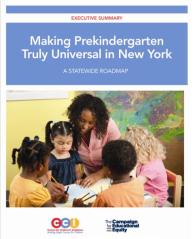
Making Pre-K Truly Universal in New York State

The Campaign for Educational Equity (CEE) and the Center for Children’s Initiatives (CCI) released a new proposal today that offers New York State a clear and responsible roadmap for boosting children’s educational and social success through wise investments in pre-K.  Informed by consultations with more than 100 public education and early childhood experts, advocates, teachers, and administrators across the state, the proposal draws on lessons learned in other states along as well as recommendations from leading national researchers and education economists.

preK image

Over eight years, our plan will expand access to pre-K services for three and four year olds while establishing pre-K, like kindergarten, as a core part of New York State’s education system and linking funding to high-quality standards, with the goal of eliminating early opportunity gaps and boosting long-term educational outcomes. “Access to high-quality, full-day pre-K is an important component of the opportunity for a sound basic education that New York’s highest court has declared to be the right of every child in New York State,” said Michael Rebell, executive director of the Campaign for Educational Equity.

Arriving just months after President Obama and the U.S. Department of Education’s recently announced plan for a ten-year, $10 billion investment in public preschool programs, our plan expands the groundbreaking pre-K program initiated by State Assembly Speaker Sheldon Silver in 1997 (but which is currently available only to four-year olds and only on a half-day basis).

The proposal also builds on the pre-K competitive-grant program that Governor Cuomo introduced earlier this year, committing to serving several thousand more four-year olds in high-quality full-day programs. The governor’s New NY Education Reform Commission, nudged by commission member Michael Rebell and others, called earlier this year for a “seamless pipeline” of educational services from birth, including full-day prekindergarten, as the next strategic and equitable step toward educational excellence and preparing New York’s children for college and careers. Like the Commission, we know that research shows that the near-term as well as long-term benefits for children, schools, taxpayers, and communities far exceed the cost.

Read the proposal and stay tuned for more blog posts about this exciting plan to strengthen New York by ensuring all children the early learning opportunities they need and deserve.

Help Educators Teach Higher-Level Skills

As highlighted in a recent report from the Center for New York City Affairs, only 29% of the students in New York City’s class of 2012 were exempt from taking remedial courses at the City University of New York because they earned a Regents diploma and achieved acceptable scores on the English and math Regents exams. This very low percentage of college-ready students is less surprising once you factor in another of the Center’s findings: many teachers, spread thin, were prioritizing boosting graduation rates and preparing students to meet the minimum requirements on state exams (two important indicators for which they are increasingly being held accountable) rather readying students for college-level work, which they saw as a higher bar.

On a related note, our own statewide study (see this December 2012 report) found many teachers are inadequately prepared and under-supported, often for lack of resources at the school level, to address their professional learning needs in a way that would allow them to meet their students’ needs. Consider the following examples:

In the vast majority of schools (28 of 33), in one or more core subject areas (English language arts, mathematics, science, and social studies), students were being taught by teachers who were not adequately trained to provide effective instruction for students struggling academically. The percentage of classroom and core subject area teachers whose training and effectiveness were deemed inadequate ranged from a low of 7% to a high of 80%, with an average among all 33 schools of 20%.

On average, the schools reported that over half of these teachers could become effective with sufficient professional development and supports, but schools lacked the resources to provide these. Eighteen schools reported that, on average, 35% of their special education teachers were not adequately trained to meet the needs of students in their classes.

Nearly all schools (30 of 33) lacked sufficient assistant principals, department heads, or other administrators to carry out mandated annual professional performance reviews and provide professional support to teachers. Five schools were unable to provide any mentoring for new teachers.

New York needs to put its resources where its standards are. Raising standards and speeches peppered with “accountability” tough talk will not make New York’s children college ready. It’s time to hold the state and city accountable for providing the resources for professional development and other capacity-building opportunities that will empower New York teachers to ensure that New York students are truly college ready.

Guidance Counselors, Vital Links to College, are Becoming Scarce Resources

Guidance counselors in New York State have a lot of important duties. State law requires that they support students who exhibit attendance, academic, behavioral or adjustment problems; support academic intervention and response to intervention services; provide a safe and orderly climate for learning; help elementary school students and their families select middle schools (and middle school students and their families select high schools);  undertake annual reviews of each student’s educational program and develop individual high school or postsecondary education and career plans; provide (individually or in cooperation with classroom teachers) grade-level instruction about academic and career planning; facilitate the college application process; and encourage parental awareness and involvement.

Yet in our study of high-needs schools around the state, more than two-thirds (25 of 33) lacked a sufficient number of guidance counselors to provide all of these basic supports for all students. Part of the reason is that New York has no required student-to-counselor ratios, so when school budgets are cut, guidance counselors jobs are on chopping block.

The Center for New York City Affairs reported in its September 2013 publication “Creating College Ready Communities” that over 60% of NYC guidance counselors manage caseloads ranging from 100 to 300 students, with many counselors struggling to singlehandedly meet the needs of over 300 students. In our own study, we saw caseloads of up to 600 high school students to a single guidance counselor. And, sadly, 11 of the 12 high schools we studied lacked sufficient staffing to provide college-related counseling to all the students who needed it.

Policymakers were also alerted to the depth and urgency of this problem in October 2012, when NYC Comptroller John Liu released a report calling upon the city to more than double the number of guidance counselors in public schools. Adding 1,600 counselors to the existing 1,300 counselors, Liu calculated, would allow each counselor to manage a caseload of roughly 100 (down from a student-to-counselor ratio of 259 to 1) and better address the needs of the 78% of public-school students whom the NYC DOE had deemed not ready for college.

In communities where few family members or neighbors have completed college, guidance counselors play a vital role in helping students understand which high-school classes colleges want to see on a transcript, how to research colleges and prepare applications for admission, how to apply for financial aid and scholarships and so on. Given the importance of that type of information as well as many students’ unfamiliarity with the college-admissions process, student-to-counselor ratios must be small in order to provide the personalized attention that each young person needs.

The Center describes this lack of adequate guidance counselors as a significant factor contributing to what it calls the “aspirations gap” and, noting that many schools do not provide students proper college-related guidance until they reach 11th grade, recommends that students receive these types of supports starting in middle school.

Many NYC High Schools are Unable to Provide Basic Math and Science Courses Needed to Ensure College Readiness

According to the Center for New York City Affairs, many schools, especially in their science and math departments, lack the types of advanced courses that students need in order to prepare appropriately for college. Examining data for 342 high schools throughout NYC, the Center found that only 28 of those schools offered Algebra 2, chemistry, and physics. But here is the worst part: 46 schools did not offer even one of the three.

As noted in our December 2012 report, New York State currently requires only that schools offer each student three units of math at a level beyond whichever math class he or she completed in 8th grade. Technically, schools do not have to offer a fourth year of math, and many do not. As a result, there are thousands of high school students throughout NYC and NYS who are fully prepared to take calculus, for example, but will never have the opportunity because their schools are unable to provide the class.

Several schools in our study lacked adequate resources to meet the state’s minimum instructional requirements in mathematics, never mind opportunities to offer advanced or Advanced Placement courses. In the two high schools plagued by that problem, students who had completed Algebra I in 8th grade and Geometry and Algebra II in the 9th and 10th grades, respectively, did not have full access to precalculus, the third unit of mathematics required for high school graduation, much less the opportunity to take math all four years of high school. One school lacked a sufficient number of teachers in its math department even to offer precalculus, and the other school could provide precalculus only to a small handful of students who could be accommodated at an adjacent school.

Another eight schools out of the 33 in our study said that, while they were meeting minimum state requirements for curricular offerings and instructional time in math, they lacked resources to provide a fourth year of math for interested, qualified students, and they were unable to provide extra math help for struggling students.

Furthermore, in science, 13 of the 33 schools in our study were unable to offer students even the minimum amount of science instructional time required by New York State.

While you do need excellent learning opportunities in math and science to become a rocket scientist, it doesn’t take rocket science to figure this out: if New York schools are unable to offer a full college preparatory curriculum, students will continue to enter college unprepared.

Getting “College Readiness” Right(s)

A new Center for New York City Affairs report entitled “Creating College Ready Communities” provides additional evidence that many NYC students are being shortchanged on the educational opportunities they must have to meet state learning standards and the basic supports they need to be ready to succeed in and graduate from college. The report is based on four years of “front-line” research in 12 high schools and two middle schools, all with large numbers of students from families in or near poverty. Their researchers also interviewed more than 250 educators, guidance counselors, college experts and policymakers and surveyed more than 300 students and teachers. Although the Center’s report avoids pointing fingers, its findings are an indictment of the city and state governments’ failure to fulfill their legal and moral obligations to New York’s children.

Many of the findings highlighted in the Center’s report came as no surprise to the Campaign for Educational Equity team, as much of the data mirror findings from our Deficient Resources report detailing the resource gaps in 33 high-need schools in eight districts throughout New York State, including 12 schools in New York City. The fact that these serious inadequacies, some of which violate state law, have been documented in more schools raises additional red flags that students’ educational rights are being widely violated.

NYC Department of Education Chancellor Dennis Walcott in 2011 announced that the city’s goal would be “making sure all of our children are college ready and ready to work.” The Center’s report notes that while the city has made inroads in better preparing students for college, many significant hurdles remain. In New York City, about 25% of students drop out of college by the end of freshman year. Among students who entered ninth grade in a typical public high school in 2007, only about half graduated from high school and enrolled in college on time. In the City University of New York system, the college destination for most NYC students pursuing higher education, the average three-year graduation rate for community colleges is an abysmal 16% and the average six-year graduation rate for four-year colleges is only 54%.

The Center’s report draws clear lines from the lack of necessary instructional support and college-related guidance at the school level to the poor college outcomes of NYC students. In future blog posts, we will highlight some of these findings, as well as our own parallel conclusions.

State Ed. Department and Regents Infringe on the Right of Struggling Students to Extra Support

You may not know this, but New York students who score below proficiency on state tests (i.e., kids who get 1s and 2s)—as well as students who are at risk of not meeting such standards—have a right, according to state education regulations, to extra supports to ensure they succeed. All of these students are entitled to “academic intervention services” (AIS), which may include tutoring, small group instruction, or even an extra class, and/or counseling and study skills help.

This extra support is vital to give some children the boost they need to master material and progress at grade level and graduate on time. It particularly critical when test scores have such high stakes attached to them — for students, teachers, and schools. Such extra help is also part of the “platform of extra services” that the court in the CFE litigation said was necessary to provide “at risk” students a meaningful opportunity for a sound basic education.

Last week however, in response to large numbers of students doing poorly on the tougher new statewide tests that were administered last spring, the New York State Education Department asked the Board of Regents (its boss) for permission to limit the number of students who would be eligible for AIS services during the current school year to approximately the same number who were eligible last year. The Regents approved the request even though the test results show that many more students need extra support to meet the more demanding new standards. Schools and school districts are now compelled to provide extra supports to only some of their students who score below proficiency.

At a time when the state is loudly touting its efforts to raise standards, this makes NO sense —that is, unless, you recognize that providing children with extra support to help them meet the new Common Core State Standards means more teacher time and expertise and would probably require the state legislature to provide local school districts with additional funds to be able to meet the needs of all the students who should now be eligible for these services.

Resources for sufficient, effective academic intervention services were already in short supply even before the recent Regents’ action. Research conducted by the Campaign for Educational Equity during the 2011-12 school year uncovered shocking deficiencies in schools’ ability to provide AIS (see pages 38-40) in high-need districts around the state. The state learning standards that year were lower, and, yet, even then, in every single school in our study, students struggling academically were being shortchanged on extra support.

This latest reduction of protections for vulnerable students is a big step in the wrong direction. Instead of providing school districts with permission to provide needed extra help to fewer students, the NYSED and Regents should insist that currently inadequate efforts be improved and expanded.

Is your school providing extra supports to all students who need them? Let us know!

Know Your (Educational) Rights

At the Campaign for Educational Equity, we have been working hard over the past couple of years to help New Yorkers understand and safeguard students’ educational rights. Yes, our students have educational rights! These rights are granted not by the U.S. constitution but from the constitution of the State of New York. And they don’t disappear during hard economic times.

This is important. The state constitution says our students have rights that must be honored, regardless of the color of our skin, the size or value of our family’s bank account or home, where we happen to live, or whether we happen to be attending school during flush financial times or lean ones.

What educational rights are guaranteed to all New York students by the state constitution?

In December 2012, the Campaign published a report that, for the first time, analyzes all of the relevant judicial, legislative, and regulatory requirements and sets out in detail what resources, services, and supports every school must be able to provide for all of its students. State-required resources include such basics as enough qualified teachers to provide a complete curriculum, including art, music, and gym, and advanced and AP classes; class sizes that are appropriate to the needs of the students; and suitable facilities, including libraries and laboratories that all students can use.

We also released a major research study in which we investigated the availability of these constitutional resources in 33 high-needs schools throughout New York State. Following dozens of on-site school visits and interviews with administrators, teachers, and student-support staff, we found evidence of serious resource deficiencies that represented extensive violations of students’ rights. In the months since those reports debuted, funding inequities have not changed significantly, and schools are still unable to provide students with the basic educational resources to which they are entitled.

Starting today, and over the coming weeks, we are publishing some of our study’s findings in the form of user-friendly, two-to-four-page research briefs (in English and Spanish). We hope these short handouts will provide useful information to New Yorkers who don’t have the time to read through our lengthy reports.

When you see our initial summary brief (available now!) and the issue-specific briefs that will follow, you may get angry about the educational injustices they point out, you may be disappointed in New York State’s perennial failure to honor children’s educational rights, but we hope you will not stop there.

Please use and share these briefs to raise awareness among your friends and family members, at your school, at community meetings, in your blog writing and social-media posts. Make sure other New Yorkers know their educational rights, so that we can work together to secure the resources to ensure all New York children the educational opportunities they deserve and on which all of our futures depend.

Some upcoming issue briefs:

School Facilities
Class Size
Resources for English Language Learners

Welcome to the Campaign for Educational Equity blog!

We are a research and policy center at Teachers College, Columbia University, that strives to define and secure comprehensive educational opportunities for all children. Headed by education scholar and legal advocate Michael A. Rebell and policy director Jessica R. Wolff, the Campaign is focused on achieving systemic change through research, legal work, policy development, and advocacy.

We hope this blog will serve as a catalyst for conversations around students’ rights, school resources, and educational opportunities. We will use the posts to share our work with you — parents, students, educators, elected officials, advocates, community members, media, researchers, CBOs, school officials. Additionally, taking a national perspective but with a focus on New York, we will share our analysis of education news from around the country and how these issues affect students. You can also expect posts from guest bloggers, including students and teachers.

To learn about the Campaign’s Safeguarding Sound Basic Education project, check out our recent Essential Resources and Deficient Resources reports, which enumerate the resources constitutionally required for a meaningful education and document the extent to which students across the state have (or lack) access to these basic resources. And please sign up to join our listserv, and connect with us on Facebook and Twitter.

Thank you for your interest and for joining us and our guest bloggers in an important dialogue to help solidify and secure students’ rights.