Setting the Record Straight: The Truth About School Funding in New York

It’s an exciting time for the future of public education in New York. Thanks to the support of many parents, community organizers, policymakers, superintendents, advocates, and others, last Tuesday, Michael A. Rebell filed the New Yorkers for Students’ Educational Rights (NYSER) v. the State of New York lawsuit. The NYSER lawsuit charges that the state is neglecting its constitutional obligation to ensure that every school has sufficient funding to provide all students with a meaningful educational opportunity.

Now that the lawsuit has been filed, many individuals and groups will tackle the hard work of spreading the word about the case and the issues it represents. CEE has started preparing tools to help you explain and disseminate information about the lawsuit and the state of education funding in New York. These will be especially important as we face a governor who seems to prefer to perpetuate tired myths to facing the facts about students’ needs.

To help you dispel such myths, CEE has created a fact sheet, Setting the Record Straight: The Truth About School Funding in New York. Click here to read and share.

And check out these other useful tools related to NYSER and the new lawsuit,

NYSER v. State Frequently Asked Questions

NYSER v. State Press Release

NYSER v. State Complaint

Major New Funding Litigation Filed in New York State

Fifteen parents from throughout New York State, along with a coalition of statewide education groups, filed a lawsuit yesterday on behalf of the state’s public school students, charging that the state is neglecting its constitutional obligation to ensure that every school has sufficient funding to provide all students a meaningful educational opportunity. The suit, entitled New Yorkers for Students’ Educational Rights (NYSER) v. the State of New York, is being led by Michael A. Rebell, who successfully litigated the Campaign for Fiscal Equity (CFE) v. the State of New York case.

The suit alleges that, in many schools around the state, schools are unable to provide students with the full range of resources that are constitutionally required because of limited budgets. In these schools, students share textbooks and can’t take books home after school. Classrooms are overcrowded at a time when higher standards require even more individualized support. Tutoring and other supports for students who are struggling academically are rationed only to a few children. Advanced and AP classes; art and music programs, and important extracurricular activities like school government and school newspaper have been severely cut back or eliminated in many schools. College and career counseling is nonexistent in many places. Even state-required instruction in areas like science, social studies, physical education, and foreign languages has been curtailed.

“In spite of the persistent demands of parents, students, educators, and advocates, the state government has continued to neglect its responsibility to our students,” said Rebell. “The governor’s education reform commission, on which I sat, refused to even consider these issues. We have no other recourse but to go back to court. Too many of our children will continue to suffer the lifelong consequences of an inadequate education – and New York will continue to bear this economic burden – if we do not take action now.”

The plaintiffs include 15 individual parents and students from New York City and all parts of the state and New Yorkers for Students’ Educational Rights (NYSER), a statewide coalition that was recently formed to bring the lawsuit and to promote public engagement by parents, students, administrators, teachers, advocates, and the public at large to support its aims. The defendants are the State of New York, Governor Andrew Cuomo, the Board of Regents, and State Education Commissioner John King.

NYSER represents the interests of students and their families; its members include the Center for Children’s Initiatives, Class Size Matters, the New York City Parents Union, NYC Community Education Councils 5, 6, and 28, the New York State Association of School Business Officials, the New York State Council of School Superintendents, the New York State Parent Teachers Association, the New York State School Boards Association, Parents for Public Schools of Syracuse, Inc., Reform Educational Finance Inequities Today, Rural Schools Association, and the Statewide School Finance Consortium. Additional organizations are expected to join NYSER in the near future.

The lawsuit seeks to win a rapid court decision that will (1) provide immediate relief for schools by forcing the state to end unconstitutional practices that currently preclude adequate funding for schools; and (2) order new reforms to the state education law and the state’s school financing system to guarantee that now and for the future every school is provided adequate funding and is able provide all students a meaningful educational opportunity.

“Our goal is to end the state government’s neglect of its constitutional responsibility to ensure that all New York schools have sufficient funding to meet students’ educational needs,” said Rebell. “While Governor Cuomo claims that the state spends more on education than any other state in the nation, the reality is that the state contains some of the highest spending and highest achieving school districts in the country, but the distribution of education spending is more inequitable than in most other states, and vast numbers of students throughout the state are not being provided a meaningful educational opportunity.”

CEE will provide news and updates on NYSER through Facebook and Twitter. To learn more about how you can join or support NYSER, please send an email to NYSERcoalition@gmail.com. Basic information about the lawsuit, including the complaint, can be found at NYSER’s website address: www.NYSER.org.

CEE’s Analysis of Governor Cuomo’s 2014-2015 Executive Budget Proposals for Education

Governor Andrew Cuomo’s executive budget proposals for 2014-15, while not without some bright points, were largely disappointing, ignoring the ongoing effects on our students — and the risk to New York’s economic future — of the state’s failure to meet its constitutional school-funding obligations.

The good news was that, building on recommendations from his New NY Education Commission, the governor committed the state to implement universal, high-quality full-day prekindergarten programs, entirely funded by the state, within five years. In addition, he proposed a new $2 billion bond act that would provide for enhanced education technology in the schools and additional construction of new prekindergarten classroom space.

The bad news is that the governor’s proposal continues to underfund basic K-12 school operations. His budget actually would provide a substantially smaller increase in basic foundation aid than he proposed and the legislature enacted last year, and it would maintain for the foreseeable future the unconstitutional “gap elimination adjustment” that under his plan would deprive students throughout the state of approximately $1.3 billion for the next school year.

I.            Progress on Pre-K

Last year Governor Cuomo announced his support for full-day prekindergarten programs for students in high-need school districts and proposed a $25 million competitive grant program to initiate the effort. This year, he has taken a major leap beyond that initial gesture. The executive budget proposes that the state achieve universal full-day pre-K for all students within five years. For 2014-15, his budget would commit $100 million toward this program, and he anticipates that the state commitment would grow “by at least” an additional $100 million per year for the four years after that. (This funding would be on top of the approximately $385 million the state currently expends to support half-day pre-K in 441 of the state’s 697 school districts.)

Cuomo’s proposal implies that once the state reaches a funding plateau of $500 million above current annual expenditures for full-day pre-K in five years, the funding needs for universal pre-K statewide will have been met. A detailed analysis undertaken by the Campaign for Educational Equity and the Center for Children’s Initiatives last fall indicated that approximately double that amount, or $1 billion in increased funding, would actually be needed to support a high-quality universal statewide program. Cuomo has provided no cost figures or analysis to explain how he arrived at his substantially lower figure.

New York City Mayor Bill de Blasio is still asserting that the city needs to impose a new income surtax on very high-income taxpayers in order to guarantee an effective, high-quality full-day pre-K program for all of the city’s four year olds. De Blasio’s position has merit. Twice in recent years, the state has announced a commitment to achieve universal pre-K (albeit for half-day programs) by a future target date, and both times it has failed to achieve that end. In 1997, the legislature adopted a “LADDER program” that promised full funding for universal pre-K within five years; again, in 2007, Governor Eliot Spitzer promised that this time full funding for universal pre-K would be accomplished in four years. In both of these situations, after two years of increased funding, political support dwindled, the program stalled, and the state remains far from achieving either of these universal pre-K goals.

De Blasio’s “millionaires’ tax” would raise $500 million per year, of which the mayor would allocate $342 million to fund universal pre-K. The $342 full-funding estimate may, however, fall short of the mark. De Blasio bases his figure on an expectation that a high-quality program can be provided in New York City for about $10,000 a year. Such high-quality programs for high-need children have been achieved in the “Abbott” districts in New Jersey, but at a cost of $13,000-$14,000 per year. Governor Cuomo’s promised state funding for full-day pre-K may, therefore, be important as a necessary supplement that can ensure that New York City’s program will be successfully mounted without any budgetary shortfalls.

The remaining approximately $190 million that Mayor de Blasio expects to obtain from his “millionaires’ tax” he would use to provide afterschool programs to two-thirds of the middle school students in the city. Governor Cuomo’s budget proposal also seeks to upstage Mayor de Blasio in this area, as the governor called for a new state afterschool funding program that would provide $200 million per year statewide by year 5. Here again, the amount the governor identified seems inadequate to the need, and no figures explaining this rate have been provided. More troubling, the possibility of these afterschool funds actually materializing seems even more ephemeral than the pre-K funds, since Cuomo includes no additional afterschool funding in his 2014-15 budget proposal and anticipates initiating the program in 2015-16—after his desired reelection.

II.         RETREAT ON K-12 FUNDING

The governor’s budget proposal calls for an increase of $608 million in formula-based aid for K-12 programs in school districts for 2014-15. About $285 million of this amount would support increased reimbursement in expense-based programs such as building aid, pupil transportation, and BOCES support. Only $323 million would be provided for foundation aid, the core operating funds that support basic instructional programs. Technically, the $323 million is not even an increase; rather it is a reduction in the approximately $1.6 billion “temporary” gap elimination adjustment (GEA), a ruse by which the state has, for the past four years, subtracted substantial amounts from the foundation aid owed to school districts in order to cover a supposed shortfall in the state’s overall budget.

Since the governor announced that the state actually has a budget surplus this year that he proposed to use to reduce a variety of business, estate, and property taxes, the avowed justification for continuing the “gap elimination adjustment” no longer exists. In any event, subtracting sums from the amount that the legislature itself has determined is necessary to provide students the opportunity for a sound basic education is a violation of Article XI § 1 of the state constitution. (And the foundation aid base from which the current GEA is being subtracted is itself substantially below the full amount that the legislature determined in the wake of the CFE litigation in 2007 was necessary to meet constitutional requirements. Even with the governor’s slight reduction in the GEA this year, the full shortfall actually comes to approximately $3.5 billion.)

The cap on increases in property tax levies that the governor and the legislature enacted on school districts other than the Big Five cities several years ago will also be more severe this year. Although the cap is generally perceived to amount to 2%, this year the way the applicable formula works out, districts will only be able to raise their taxes by a maximum of 1.46% without obtaining a 60% taxpayer vote. The governor’s tax relief proposals would make it even more difficult for school districts in need of greater increases to obtain the 60% supermajority, since his plan would rebate to each taxpayer the district’s tax increase, but only if the increase is below the cap.

Last year, the legislature increased formula-based aids to school districts by $937 million, a 4.7% increase. The governor’s current $608 million proposal would provide only a 2.91% increase this year. Under the governor’s meager scheme, New York City would receive a 2.76% increase, $200 million (not counting building aid), Syracuse would receive a 1.74% increase, and Buffalo would see only a 1.72% increase. The Education Conference Board estimates that school districts will need at least a 3.7% increase just to meet mandatory cost increases and maintain current programs and staffing levels.

We hope the legislature will not accept the governor’s low figures and will be much more proactive in meeting the pressing educational needs of New York State’s students and guaranteeing their constitutional rights.

 

New Yorkers to Governor Cuomo: Kids Can’t Wait for Their Education Rights

The Campaign for Educational Equity convened a major statewide conference last week titled, “Right Makes Might: Working Together to Ensure NY Students’ Right to a Sound Basic Education Now and for the Future.” Hosted at the New York State School Boards Association near Albany, the conference served as a platform to discuss and to rally key education stakeholders around the inadequacies of current state education funding and the urgent need for legal and political action to safeguard the education rights of all children.

Approximately 100 people attended, representing diverse school constituencies: upstate and downstate; urban, rural, and suburban; and from many different racial and ethnic backgrounds. Participants included parents, teachers, school board members, district superintendents, community organizers, lawyers, and policy advocates. The diverse attendees all echoed the same sentiment: in too many New York school districts, children are suffering because teaching and learning have been undermined by inadequate funding, disparities in educational opportunity remain vast, and immediate action is needed to ensure that all schools can provide their students with at least the basic resources they need to meet state standards.

Conference speakers included parent and NYC Community Education Council (CEC) 6 president Miriam Aristy-Farer, Sonja Jones, president of NYC CEC 5 and co-chair of Manhattan Community Board 9’s education committee, education finance expert John Yinger of the Maxwell Institute at Syracuse University, former upstate BOCES superintendent Mike Glover, Leonie Haimson of Class Size Matters, and Bob Lowry of the NYS Council of School Superintendents. They provided evidence, from the individual school level to statewide financial-data sets, of the enormous funding inadequacies around the state and their effects on children.

As Mike Glover said, “Poor kids have lost ground, particularly since the recession. The ‘American dream’ for them is increasingly distant, mythical and unobtainable…and that has tragic consequences for all children and our broader society. [They] have been consigned to a future of unemployment, underemployment, and something less than a full and rewarding citizenship in large part due to our lack of investment in their schools. That is, or should be, a source of shame and a matter of conscience for every New Yorker.”

In sessions that reviewed the recent report of the Governor Cuomo’s New NY Education Reform Commission and the governor’s executive budget proposal, these speakers, as well as former superintendent and commission member Jessica Cohen and Billy Easton of the Alliance for Quality Education, sharply critiqued Governor Cuomo’s inadequate response to the plight of students, both in his meager state-school-aid proposals and in his education commission’s failure to address central education issues, including funding. Easton urged the group to raise their voices and tell the state legislature that the governor’s budget proposals are not good enough.

Michael Rebell, who litigated the successful CFE case, discussed the need for new legal action at this point, utilizing evidence from research that CEE completed in high-needs districts around New York State. This research showed serious inadequacies in basic educational resources that plainly violated students’ right to the opportunity for a sound basic education.

Conference participants walked away with a renewed sense of optimism, determination, and unity around shared principles and goals and also concrete ideas about how to coordinate efforts over the next few months in a way that benefits all parties.

To learn more about the conference, the new lawsuit, and the Campaign for Educational Equity’s initiatives, please email us at equity@tc.edu.

New NY Education Reform Commission Releases its final report

Governor Andrew Cuomo’s New NY Education Reform Commission released its final report. The report includes recommendations to expand full-day pre-kindergarten, upgrade classroom technology and rewarding top teachers. CEE executive director Michael Rebell, who was a member of the commission, wrote an important supplemental statement, criticizing the report’s failure “to deal at all with such major issues as funding, special education, the lack of appropriate supports for English language learners, as well as ignoring major current controversies such as implementation of the Annual Professional Performance Review (APPR), and common core systems.”

Please read Michael’s statement here and the find the full report here.

Governor Cuomo Needs a Priority Adjustment

Yesterday, Governor Cuomo announced a $2 billion tax cut proposal, largely accepting the recommendations of his tax commission. At a time when schools around the state are unable to supply their students with basic educational resources, we think Gov. Cuomo’s priorities are totally askew. Read more about Gov. Cuomo’s obligation to our children in Michael Rebell’s New York Daily News op-ed about the tax cut and its repercussions for New York students.

Also, read and share our Know Your Rights handouts, which set out what resources, services, and supports every New York school must be able to provide for all of its students under the state constitution and summarizes CEE’s analysis of the availability of these constitutional resources in 33 high-needs schools around New York State. Tax cuts cannot come at the expense of students’ right to a quality education.

In New York, Violating Students’ Right to Essential Instructional Materials

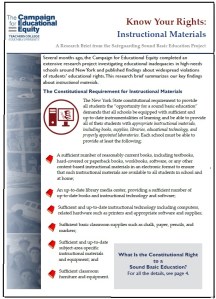
Several months ago we released a groundbreaking report detailing the lack of basic educational resources in “high-need” school districts  throughout New York State. One of the key resource areas we studied was instructional materials (see p.50). Among our most glaring findings: for lack of adequate funding, students in some classrooms were forced to share textbooks, and, in a number of schools, couldn’t take books home because teachers had just one set of books for all their classes. This left many young people without the means to study for a test, catch up on reading, or review the material they learned during the school day.

IM_ImageBooks were not the only instructional materials in short supply. Some under-resourced schools were unable to assign homework that required certain math tools, like calculators, because neither the school nor students’ families could afford to purchase them. Other schools assigned such homework, though they knew that some students would not have the needed tools at home.

Our new user-friendly handout, Know Your Rights: Instructional Materials explains the constitutional requirement for instructional materials and details the violations we found in schools. We urge you to check out this handout, as well as our other Know Your Rights handouts, which we have started to release and will continue to publish.

recent article in the Epoch Times  provided a fresh reminder that violations of students’ educational rights under state law persist: students (and teachers) are still not equipped with the basic resources they need to meet state standards. According to one parent leader in Upper Manhattan, six schools in her district did not receive Common Core-aligned instructional materials until more than a month into this school year, though there were high stakes, like teachers and school evaluations, attached to Common Core aligned tests. “They didn’t prepare the students, they didn’t prepare the teachers, so it’s completely unfair,” she said.’”

New York State is generous with rhetoric about raising standards but too often M.I.A. when it comes to providing the resources needed for teaching and learning.

Know Your Rights: Physical Education

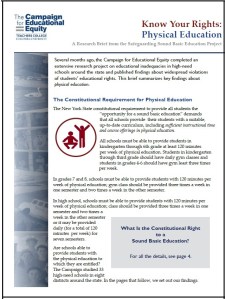
You probably know that many students in New York City and other districts around the state lack adequate access to physical education. Our own research in 33 high-needs New York schools showed that almost half of the schools weren’t able to meet the state’s minimum requirements for instructional time in PE, largely because of a lack of enough funding for teachers and appropriate gym space.

phys_ed_imageOur findings were disheartening. We saw a school that had no gym teacher and one that could fit all of its PE equipment into one mesh bag. We visited schools with PE classes serving up to 70 students, and we witnessed students with disabilities doing phys. ed. class in public hallways. We saw high schools with exciting PE facilities like tracks, weight rooms, dance studios, and even swimming pools, but these were all off limits to students because of a lack of staffing.

This sad situation persists in spite of research that connects physical education to a host of improved outcomes for children and youth, including academic outcomes.

What you may not know is that New York State’s constitution requires the state to ensure that all schools have sufficient funding to provide all students a “sound basic education” and this includes sufficient instructional time and course offerings in physical education.

Our new user-friendly handout, Know Your Rights: Physical Education explains the constitutional requirement for phys ed. and details the violations we found in schools. We urge you to check out this handout, as well as our other Know Your Rights handouts, which we have started to release and will continue to publish. We hope this series will empower you – parents, advocates, policymakers, educators, and students – to become better informed about the state’s specific constitutional education obligations to students. We hope you will share it to help others better understand students’ legal rights.

The Campaign is excited to be working with a number advocacy and research groups, including Women’s City Club, New York Lawyers for the Public Interest, and Phys Ed Plus, to ensure proper access to physical education in New York City. We hope you join in this important conversation.

Inequities in Access to the Arts Jeopardize Student Success

“Our city is home to some of the greatest public schools in the nation where innovation and creativity thrive. And yet we have hundreds of schools that are subpar, under-resourced in the arts, sciences and other areas, and generally not providing the rich and engaging curriculum that students deserve and parents expect,” writes the head of the Center for Arts Education in SchoolBook today. “This is problematic from an equity point of view, but is also counter-productive to our educational goals and ambitions as a city.”

We couldn’t agree more. Own research in high-needs schools statewide found that nearly half were not able to provide their students even state-required minimum course offerings in art.

Music and the arts impart to students critical skills such as the ability to innovate, critique and collaborate, according to numerous studies discussed in today’s SchoolBook article.  Studies demonstrate the connection between the skills gained from quality arts education and future career success. Further, unreleased research findings from an arts-in-education development program indicate that the arts program helped improve English and math scores on state exams compared to peer schools.

The state needs to ensure all schools have sufficient funding so all students can receive ample, quality arts experiences.

It’s Not Too Late for the Regents to Stop Reductions in Extra Supports for Struggling Students

Back in September we informed you about the harmful, inequitable, and unconstitutional decision made by the New York Board of Regents to approve a request from the New York State Education Department to eliminate the right to additional instructional support (see p. 11) for many thousands of students who were unable to pass the new state exams this past spring.

As we described, because larger numbers of students did poorly on the tougher new statewide tests, the state ed. department asked the Regents for permission to limit the number of students who would be eligible for academic intervention services (AIS)—extra support to help students meet demanding new standards—to the same number of students who received such support last year. As we said, at a time when the state claims to want to raise standards, this makes no sense.

Why would the New York’s educational leadership deny so many students their right to extra academic help? Purely because providing these needed instructional supports would impose extra costs on already cash-strapped schools and school districts. This proposed policy shift is yet another example of how basic educational resources and services are currently being jeopardized by inadequate state funding for schools.

The good news is that it is not too late for the Regents to change their mind and restore these important supports to students who need them. It turns out that the Regents’ decision in September was only a temporary, emergency amendment. To make the decision permanent, a final vote must be taken during the Regents’ regularly scheduled two-day meeting in Albany on December 15-16, roughly three weeks away.

At its November meeting, the Regents agreed to allow SED to continue denying New York students the right to more help this school year if they failed the new tests last spring. And it is likely they will continue this inequitable and unconstitutional action In December unless New Yorkers send them a clear message that they oppose this clear violation of our children’s educational rights.

There are many ways to express your views to the Regents and the state ed. department, to your state representatives, and to the governor. You can also raise this issue at your neighborhood school, throughout your personal and professional networks, and at every education-related public meeting (e.g., school board, community education council, government hearings on education) you can attend between now and December 15th.

Working together, we can ensure all of our children the educational opportunities they need in order to succeed in school and to which they are entitled under the state constitution.