Former Gov. Spitzer Underscores NY’s Constitutional School-Funding Obligation

In late January, I wrote an op-ed piece in the New York Daily News that took issue with the position espoused a few days earlier in an op-ed by Paul Francis, currently a Deputy Secretary to Gov. Andrew Cuomo and formerly the Budget Director for Gov. Eliot Spitzer.

Francis had claimed that the Foundation Aid formula, the state’s primary mechanism for distributing school funding, that was adopted by the New York State legislature in 2007, was merely “aspirational” and had not been a constitutionally mandated response to the Court of Appeals’ orders in the CFE litigation.

Yesterday’s Times Union op-ed by former Gov. Spitzer fully confirms that the Foundation Aid formula was indeed “constitutionally mandated.” Below is Spitzer’s statement.

Michael A. Rebell

Times Union, 2/15/17: Funding our schools adequately has long been viewed as a moral imperative. In 2006, it also became a constitutional imperative.

That year, the New York Court of Appeals, our highest court, issued a final ruling in the Campaign for Fiscal Equity lawsuit, holding that all children in New York state have the constitutional right to a “sound basic education.” Unfortunately, the court also found we were failing to fulfill that obligation.

The bipartisan budget that was enacted in 2007 confronted this failure and constitutional obligation directly — we substituted a backroom politically driven funding process that had both underfunded and misallocated education aid with a new Foundation Aid formula. We put in place a data-driven overhaul of the way New York funded its public schools. The court ruling created a legal imperative that brought political agreement to an arena traditionally fraught with divisiveness.

The Foundation Aid formula was proposed and enacted as a direct result of the CFE litigation. As contentious as school funding debates had often been, there was agreement that Foundation Aid was a principled and constitutionally mandated step forward. The Republican Senate majority said the Foundation Aid formula fulfilled “the mandate of the Court of Appeals decision in CFE vs. The State of New York,” and the Democratic Assembly leadership said it “addresses the court-ordered requirements of the Campaign for Fiscal Equity lawsuit.”

The new formula responded to the Court of Appeals’ order that the state “align funding with need” based upon the “actual costs” of providing a “sound basic education.” The new Foundation Aid formula calculated these actual costs and recognized that the programs and services needed by students who are economically disadvantaged, those with disabilities, and English language learners are often more costly.

The new structure of Foundation Aid was designed to increase classroom operating aid by $5.5 billion statewide, phased in over four years — plus an allowance for inflation, as ordered by the Court. In the 2007-08 and 2008-09 state budgets, the funding increases were delivered on schedule.

But in the years since, the formula has been chronically underfunded. As a result, New York is now in the company of states like Mississippi and Georgia where, year-in and year-out, funding formulas are consistently ignored to the detriment of students.

And today, a decade later, as a consequence, we see in far too many schools the same conditions that led to the CFE lawsuit in the first place. That’s why I am especially disappointed that the current budget proposal would eliminate the Foundation Aid formula entirely and, with it, the $4.3 billion still owed under the formula to our schools.

The lack of funding means that, across New York, we will continue to see the glaring educational deficits we intended to address through funding the Foundation Aid formula. Elementary-grade classes are crowded with 30 students or more. Schools lack enough specialized teachers for English language learners. Guidance counselors serve 400 to 800 students, leaving little opportunity for individualized attention for students. School libraries operate with reduced hours. Summer school classes and tutoring are in short supply for students who have fallen behind and are at risk of dropping out.

New York can and must do better. We all now acknowledge that as a moral, constitutional and economic imperative we have to invest properly in the education of our children. Yet today we still are not providing children with what they are entitled to and deserve — the opportunity for a “sound basic education.”

The good news is that the solution is still on the books. Foundation Aid was enacted to comply with the court order in CFE. It’s time for the state to fund the formula fully, not repeal it.

www.timesunion.com/tuplus-opinion/article/Fully-fund-Foundation-Aid-for-New-York-s-public-10935315.php

Parent Leaders ‘Take the Law into Their Own Hands’ at Legislative Breakfast

On Saturday, February 11, an outstanding team of Central Brooklyn parent leaders affiliated with the Adelaide Sanford Institute’s (ASI) Parent Leadership Institute and supported by the Campaign for Educational Equity (CEE), outlined New York students’ educational rights and presented their own rights-focused legislative requests at a well-attended breakfast with city and state elected officials, parent leaders and their children, and local civic leaders. Please read our “Movement-Building” backstory and then the legislative-breakfast reflection by Earline and Priscilla Mensah, a dynamic Parent Leadership Institute mother-daughter duo.

MOVEMENT-BUILDING
By Joe Rogers, Jr., Director of Public Engagement / Senior Researcher, Campaign for Educational Equity

In May 2015, CEE’s Know Your Educational Rights public-engagement and research team launched a partnership with the ASI’s Parent Leadership Institute to facilitate monthly Saturday-morning educational-rights workshops, which ultimately informed over 100 parent leaders about students’ resource-related rights under New York State law. Some participants, curious about the levels of opportunity available to their children, began using our research tools to assess and report back on the availability of basic resources in their schools. The parents also benefited from candid school-resource-related conversations with a number of master educators.

In return, the parents contribute invaluable feedback and advice to help strengthen our Know Your Educational Rights handouts and tools, provide useful recommendations on how to engage the education bureaucracies in assuming responsibility for informing families of students’ rights, and continue to inspire our team with their outstanding commitment to making sure all students in their neighborhoods, not just their children, receive the quality opportunities to which they are entitled. Through their words and actions, they embody “it takes a village to raise a child.”

In September 2016, a smaller group of those parent leaders, known as the “Know Your Educational Rights Parent Ambassadors,” kicked off a months-long campaign to share their new knowledge at important forums throughout Central Brooklyn, including the public meetings of several Community Education Councils, Community Board education committees, parent associations, and the Brooklyn Borough High School Presidents Council. Inspired by the Parent Ambassadors’ powerful leadership, and grateful for the valuable new information, parents and other community members around Brooklyn and throughout NYC have begun to call upon state and local elected and education officials to inform all families about students’ educational rights by September 2017.

FAMILY REFLECTIONS ON ED.-RIGHTS-INFUSED LEGISLATIVE BREAKFAST
By Earline Mensah, Parent Ambassador, Parent Leadership Institute (Adelaide Sanford Institute) & President, Brooklyn Borough High School Presidents Council; Priscilla Mensah, Member, Parent Leadership Institute (Adelaide Sanford Institute)

“BBCCSSSE” is what you heard dozens of parents and elected officials chanting in the library of Bedford Stuyvesant’s very own Boys and Girls High School this past Saturday. This is because, on Saturday February 11, 2017, the Adelaide Sanford Institute hosted its annual legislative breakfast featuring elected officials and other members of the community, such as parents and educators.

One of the main themes of the program involved Dr. Renee Young teaching the audience members the “BBCCSSSE” chant, which stands for New York students’ fundamental resource-related rights under the state constitution: “books” (and other instructional materials, supplies, and technology), “buildings” (facilities), [appropriate] “class size,” [suitable and up-to-date] “curricula,” “services” (for students struggling academically), “safe [and orderly] environment,” “smart” (qualified educators and other school personnel), and services for English Language Learners and students with disabilities. In attendance were Assembly Members Latrice Monique Walker and Annette Robinson (retired), Council Members Inez Barron and Al Vann (retired), and State Senators Roxanne Persaud and Kevin Parker.

Parents were given the opportunity to voice their demands—to inform all parents of students’ rights by this fall and to create a network of Central Brooklyn parent resource centers—and concerns to the elected officials. Other notables included NAACP Brooklyn Chapter president L. Joy Williams; Director of the Adelaide Sanford Institute Dr. Christopher Smith; two of the hosts of the forum, Drs. Renee and Lester Young, the former of whom leads ASI’s Parent Leadership Institute and the latter of whom serves as ASI’s board chair and on the New York State Board of Regents; and Joe Rogers, Jr., of the Campaign for Educational Equity at Teachers College, Columbia University.

The morning was filled with presentations by parent leaders Earline Mensah, Lorraine Calame, and husband-and-wife team Cora Cuffey and Barry Lelitte speaking on the resources and supports that all New York State students are entitled to under the law. Before the presentation, few in the room were aware of those rights; thanks to the “BBCCSSSE” incantation, we’re sure that has greatly changed. The atmosphere was positive and inviting, with many people, including the elected officials and community leaders, winning early Valentine’s Day chocolates for demonstrating their mastery of “BBCCSSSE.”

Students’ Constitutional Rights Are Obligatory, Not “Symbolic” or “Aspirational”

By Michael Rebell

Paul Francis, deputy secretary for health and human services under Gov. Andrew Cuomo, wrote in an op-ed in yesterday’s N.Y. Daily News that the objections that public-school parents, education-law scholars, and advocates have lodged to the governor’s ongoing failure to fund our state’s public schools adequately—and his recent proposal to eliminate the state’s constitutionally required foundation-aid formula—are based on “misinformation and distortions that would be laughed out of any competent classroom.” I don’t know what classrooms Francis has been visiting lately, but I do know that the state courts do not consider the allegations of violations of students’ rights under the education article of the state constitution to be a laughing matter. In fact, in the case New Yorkers for Students’ Educational Rights (NYSER) v. State of New York, the seriousness of these charges has been upheld by two state courts and will be considered this spring by the Court of Appeals, New York’s highest court.

In Campaign for Fiscal Equity (CFE) v. State of New York, a landmark decision issued in 2003, the Court of Appeals held that every child in New York State is entitled under Article XI of the state constitution to “the opportunity for a sound basic education.” The legislature adopted a foundation-aid formula in 2007 to distribute education funding more fairly in order to comply with the court’s decision. Francis, however, appears to believe that the court’s CFE ruling is merely “symbolic” and has no lasting significance. This view is apparently shared by Governor Cuomo, who has suggested that the foundation-aid formula is “aspirational” and that he therefore need not make an effort to provide the additional $4.3 billion that the state’s schoolchildren are owed under the formula. Instead, in the executive budget proposal he issued last week, the governor has asked the legislature to erase the requirement to adhere to the foundation formula from the state’s statute books.

Francis was the former budget director for Governor Eliot Spitzer, who originally proposed the foundation-aid formula, and, for that reason, he says that he “would know… the facts.” He may know what the formula requires (which is not actually in dispute), but he clearly does not know the law. As co-counsel for the plaintiffs throughout the CFE litigation, I do know what the court actually said and what it means for public school students in New York State.

CFE was not a ruling issued solely to remedy the inadequate funding levels the court found in the New York City public schools at the time of the trial. Like other major pronouncements on constitutional rights, the CFE opinions were definitive and highly significant proclamations from the state’s highest court that articulated precisely the state’s enduring obligations to its schoolchildren. They outlined students’ rights, not just for 2003, but for as long as the education article of the state constitution remains in effect.

The court determined that annual state aid for education had for decades been determined without regard to actual student needs but through political wheeling and dealing by “three men in a room” (the governor and the leaders of the state senate and the state assembly). The court held that future state funding for education must be determined systematically in a way that would “align funding with need.” Specifically, the court held that the State must

(1) “ascertain the actual cost of providing a sound basic education;” (2) [ensure] that every school … would have the resources necessary for providing the opportunity for a sound basic education;” and (3) “ensure a system of accountability to measure whether the reforms actually provide the opportunity for a sound basic education.

The state complied with these requirements in 2007 when it enacted a Budget and Reform Act in order to, as the Assembly Education Committee put it at the time, “satisfy the requirements of the CFE court decision.” Recognizing that the funding deficiencies that the Court of Appeals had found in regard to New York City also applied statewide, the 2007 reforms were enacted, in Governor Spitzer’s words, to “provide a statewide solution to the school funding needs highlighted by the Campaign for Fiscal Equity Lawsuit.”

Paul Francis, working for the current governor, is now trying to minimize the significance of the 2007 Reform Act by spinning a simplistic and erroneous summary of what the Court of Appeals did in 2006 when an impasse had developed between Governor George Pataki and the legislature on complying with the court’s order to determine the “actual cost” of providing a sound basic education. Francis claims that, at that time, the Court of Appeals merely “codif[ied] a study by a special commission appointed by Gov. George Pataki recommending funding for New York City schools be increased by an additional $1.9 billion from combined state, federal and local sources.” Since, according to Francis, that amount of increased funding has now been paid out, nothing more is required.

In fact, however, in 2006, the Court of Appeals made clear that it was the responsibility of the governor and the legislature, and not of the court, to determine the actual costs of providing the opportunity for sound basic education to all New York students, based on students’ needs. The Court ordered the governor and the legislature to act during the next legislative session to overcome their impasse and to determine an actual cost level within a range of $1.9 billion and $5.63 billion (a figure that stemmed from the range of cost studies that the lower courts had reviewed). Governor Spitzer and the legislature did overcome the executive-legislative impasse, and, in doing so, adopted the foundation-aid formula that calculated a significantly greater weight for the needs of students living in poverty and English language learners than Governor Pataki had proposed. The result was a number much closer to the high end of the court’s designated range, rather than the low end that Governor Pataki had advocated.

For the first two years after adopting the 2007 plan, the state largely adhered to its commitment to phase-in the increases called for by the foundation formula over a four-year period. Following the recession of 2008, however, the state defaulted on its commitments and, beginning with the 2009-10 school year, has failed to provide school districts throughout the state the amount of state aid it had itself determined to be necessary to meet its constitutional obligation to fund schools fairly and adequately. During the recession years, state officials essentially conceded that their failure to provide the full amount of increased funding called for by the foundation formula was, in fact, denying children their constitutional rights. They explained that the amounts they were withholding constituted a temporary “gap elimination adjustment” that was necessitated by the demands of the recession. Once the economy recovered, this implied, they would reinstate the constitutionally mandated funding phase-in.

This “gap elimination adjustment” was itself unconstitutional because, as the courts have repeatedly held, constitutional rights cannot be put on hold because of a recession or state fiscal constraints. Now that the economy has revived, Governor Cuomo’s disregard of the state’s obligation to New York’s children is both unconstitutional and unconscionable.

The decisions the state made in 2007 to achieve constitutional compliance are not, of course, written in stone and the state could adopt a new plan for constitutional compliance that responds to changes in educational requirements and students’ needs that have occurred over the past decade. However, if the state wants to revise and update the foundation-aid formula, it must do so in a manner that complies with constitutional requirements.

Any formula changes must be based on a valid, current study to determine what is the “actual cost” of a sound basic education and to determine what revisions are needed in the distribution of funding to the school districts in order to ensure that all schools throughout the state have sufficient resources to provide all their students a meaningful educational opportunity. The state has not undertaken any such analyses and, until and unless it does, the existing foundation-aid formula stands and must be honored.

The governor’s call to abandon the foundation-aid formula and revert to the discredited “three men in a room” deal-making system for determining what the state will spend to prepare its students for their civic and economic futures is clearly unconstitutional. It must be rejected by the legislature—or, if need be, by the courts.

Governor Cuomo’s Budget Proposal Disregards Students’ Constitutional Rights

By Michael Rebell

The executive budget for the next fiscal year that Governor Andrew Cuomo issued last week flouts the constitutional right of all students in New York State to the opportunity for a sound basic education. It tramples students’ rights in two significant ways. First, the governor’s budget proposal would provide an increase of only $428 million in basic foundation aid for the schools, less than 10% of the current $4.3 billion gap between the amounts appropriated for the current year and the amounts called for in the foundation-aid formula the state adopted in 2007 to ensure fair and adequate education funding in response to the Court of Appeals’ decisions in the Campaign for Fiscal Equity (CFE) litigation. (The Regents had called for a $1.47 billion increase in foundation aid for next year and a commitment to eliminate the constitutional gap fully over the next three years.) Cuomo also calls for some tweaking of the formula that would aid high-need districts, but that slight benefit is more than outweighed by “hold-harmless” provisions that guarantee districts the same amount of money they received the previous year, whatever their actual needs, and a 1% minimum increase that will be provided for all districts, regardless of need.

Second, in an obscure maneuver that becomes apparent only when one reads the technical details of the budget legislation, the governor is proposing to eliminate the foundation-aid formula, effective in fiscal year 2019, and return the state to the ad hoc budget decision-making process that the Court of Appeals specifically held to be unconstitutional in its 2003 CFE opinion. In that decision, the court held that the state’s funding of public education must be based on the “actual cost” of providing students the opportunity for a sound basic education, one that prepares them for capable civic participation and competitive employment. Further the court said that state aid must be allocated on the basis of need and in a manner that ensures that every school has sufficient resources to provide the opportunity for a sound basic education to all of its students.

The foundation-aid formula adopted in 2007–which has not been fully funded since 2010–was developed through an extensive process that identified the actual cost of providing all students throughout the state the opportunity for a sound basic education, and established a largely equitable method for distributing aid to schools in accordance with relative need. Arguably, elements of the current foundation aid formula may be out of date and in need of revision. However, to change the current formula in conformance with constitutional requirements, the state would need to institute a new cost analysis to determine actual current costs and develop a new, equitable distribution formula. It cannot revert to determining educational allocations through political deal making, with no regard for the adequacy of funding levels or relative student need.

Cuomo packaged his total proposed FY 2018 school-funding budget as providing an increase of approximately $1 billion (or 3.9% more than last year), but this is highly misleading. About $333 million of his proposed “increase” would reimburse school districts for monies already spent for transportation and school buildings. The budget proposal also calls for $35 million in increases for after-school programs, $5 million for early-college high schools, and $22 million in charter-school reimbursement funds to school districts. The relatively small amounts provided for these programs, though desirable, should be added to the foundation-aid appropriations; setting them out as categorical spending requirements is inconsistent with the courts’ admonition that the education funding system should not be “needlessly complex.” The proposed budget also includes an unexplained $150 million “Fiscal Stabilization Fund,” which not only diverts funding from the need-based formula, but also sidesteps government transparency and accountability.

The governor’s budget proposal fails to respond to the Regents’ important call for a $100 million increase in programs for English language learners. It also fails to fulfill the commitment he made two years ago to offer a full-day universal prekindergarten program to all four year olds in New York State. This year’s executive budget provides $340 million for that program, the same amount as last year and the year before, allowing no room for expansion of the program. As in years past, $300 million will be allocated to New York City and $40 million will be available to the rest of the state. These sums may be sufficient to maintain New York City’s universal full-day pre-K program, but they are grossly insufficient to provide comparable opportunities for students in the rest of the state. The governor has also failed to consolidate six other small competitive grant programs for pre-K into the universal pre-K program, a move that would aid transparency, planning and equity; he did, however, propose a small ($5 million) increase for full- and half-day programs for three and four year olds in high-need districts.

Fortunately, the governor’s executive budget is just a proposal. The state legislature must respond to it. In past years, our legislators have provided substantially more state aid for education than the governor recommended, though still not the amounts needed for constitutional compliance. In addition, the Court of Appeals recently agreed to hear an appeal in the New Yorkers for Students’ Educational Rights (NYSER) v. State of New York litigation. Plaintiffs in that case will ask the court to clarify the state’s responsibilities in regard to compliance with the state constitution’s sound-basic-education requirements and the court’s CFE rulings.

CBC Report Highlights Foundation Formula Inequities

By Michael Rebell

cbcnycThe Citizens Budget Commission (CBC)  released a report December 2016 that argues that the legislature could fully implement New York State’s foundation formula to provide full funding for high need districts with only a total increase of $569 million in state funding, in contrast to the almost $4 billion that many advocates are calling for to fully fund the state’s foundation formula. The foundation formula was adopted by the state in 2007 in the wake of the CFE decisions, but has not been fully funded by the state since the 2008 recession.
The foundation formula largely adhered to the Court of Appeals’ directive that state education funding must be responsive to student need; it provided substantial increases for students in New York City and other high need districts throughout the state. At the same time, however, according to the CBC, the formula  included a number of hold harmless provisions, arbitrary floors, ceilings, phase-ins and add-ons that distort final funding distributions. In addition, inconsistent local share calculations do not uniformly and fairly account for a district’s ability to pay, and outdated measures of poverty understate or overstate need in many districts. It is by eliminating these aspects of the formula that inequitably benefit low wealth districts that full funding could be provided to high need districts at a relatively modest additional cost to the state, according to the CBC.

A copy of the full CBC report can be found at  http://www.cbcny.org/sites/default/files/REPORT_FOUNDATIONAID_12122016.pdf.

CEE Team Presents Policy Recommendations to NY Board of Regents

cee_presentation_regents-research-work-group_12-22-16_final-5

Download: Presentation to Regents Research Work Group

On December 15, CEE Director of Research and Policy Jessica R. Wolff and Director of Public Engagement/Senior Researcher Joe Rogers, Jr. presented to the New York State Board of Regents’ Research Work Group, which is tasked with identifying research projects that clarify, challenge and/or support Regents’ policy-making. The Regents are responsible for the general supervision of all educational activities within the state.

The presentation briefed the Regents and other key education stakeholders in attendance on CEE’s November 2016 report series, Students’ Constitutional Right to a Sound Basic Education: New York State’s Unfinished Agenda.

South Bronx Youth Share Educational-Rights Knowledge through Rap, Spoken Word

equarap

This past summer, the Campaign for Educational Equity (CEE) teamed up with THE POINT CDC, a phenomenal South Bronx-centered youth development organization, for a six-week series of interactive workshops based on our Know Your Educational Rights public-engagement model and THE POINT’s Camp PowerPoint program.

On August 11, youth participating in THE POINT’s Music and A.C.T.I.O.N. “majors”–having studied our Know Your Educational Rights handouts; interviewed students, parents, and other education leaders; and reflected on their personal in-school experiences–used their artistic talents to encourage their community to fight for educational equity!

WATCH THIS SIX-MINUTE VIDEO OF THEIR  CULMINATING PERFORMANCES:

Students, those who are most directly affected by educational rights violations and other educational injustices, must co-lead the fight for educational equity.

Our brilliant youth collaborators–supported by their artistic and community-organizing adult mentors and allies, and building on a rich tradition of youth activism–demonstrate the power and potential of their voices.

CEE’s E.D. Michael Rebell provides Legal Context for CT Educational Adequacy Litigation

As Economy Struggles, Disparity Of Wealth Becomes More Glaring(Photo by Spencer Platt/Getty Images)

In a recent article in The Atlantic, “Good School, Rich School; Bad School, Poor School,” CEE executive director Michael Rebell provides the legal context for educational adequacy litigation in Connecticut. Despite being one of the wealthiest states in the union, Connecticut is grappling with longstanding and substantial inequities. Rebell goes on to explain how, “since the 1970s, nearly every state has had litigation over equitable education.” 

Read more about the struggle to equitably fund all public schools.


Michael Rebell weighs in on Kansas Supreme Court Decision

Michael Rebell was cited in The Wichita Eagle’s recent article on the potential for a public school shut down in Kansas if the state legislature fails to comply with the recent school funding rulings,  “The Kansas Supreme Court for more than a decade has been judging the Legislature’s efforts to comply with rulings against the state in both the Montoy and Gannon v. Kansas cases. The frustrated court threw down its hammer on May 27, ruling that if the Legislature didn’t amend its latest funding formula by June 30 to be equitable to poorer districts, the state will be barred from raising, distributing or spending education funds until it does. It wasn’t the first time a state high court – or even Kansas’ high court– had delivered such a mandate. But this deadline is particularly striking, said Michael Rebell, professor of law and educational practice at Teachers College, Columbia University. ‘This time the court stance is stronger’ Rebell said. ‘And the fact that they reiterated it this close to a deadline shows they mean business.'”

Read more…

CEE Testifies at May 20th U.S. Commission on Civil Rights #EduEquity Briefing

Joe at commision

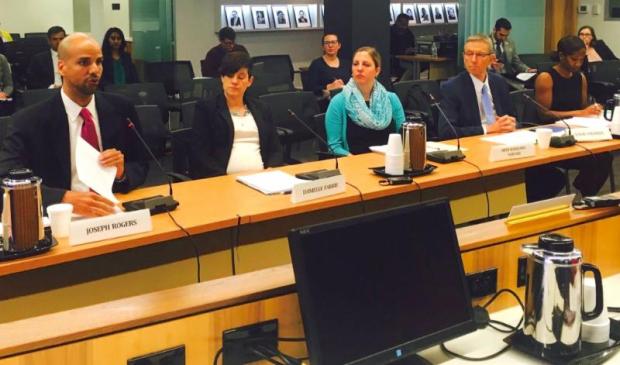
On May 20th, the Campaign for Educational Equity contributed legal, policy, and public-engagement findings and recommendations to “Public Education Funding Inequality in an Era of Increasing Concentration of Poverty and Resegregation,” a national U.S. Commission for Civil Rights briefing in Washington, D.C.

CEE researcher and director of public engagement Joe Rogers, Jr., joined state and district officials, civil rights leaders, parents, labor leaders, and representatives of the U.S. Department of Education in discussing potential solutions to longstanding racial and socioeconomic discrimination in the distribution of educational opportunity. A copy of the full transcript of the testimony can be found both here and below.

This fact-finding conversation was a sobering reminder of how (and just how many) children continue to be hurt by the broken promises and legal violations of state and local governments across the nation. It is shameful that, 62 years after Brown v. Board of Education, educational inequities continue to keep children of color and children living in poverty from fulfilling their enormous potential.

However, bold action informed by the types of research-, policy-, and public-engagement-centered recommendations discussed at the briefing can help reverse the tide of educational injustice and lead us on a path to true equity and excellence.

U.S. Commission on Civil Rights Hearing: 

Public Education Funding Inequality in an Era of
Increasing Concentration of Poverty and Resegregation

May 20, 2016

Testimony delivered by Joseph R. Rogers, Jr.
Director of Public Engagement / Senior Researcher
The Campaign for Educational Equity at Teachers College, Columbia University [1]

Good morning, commissioners, distinguished guests, and members of the public. My name is Joe Rogers, Jr., and I serve as the Director of Public Engagement and a senior researcher with the Campaign for Educational Equity at Teachers College, Columbia University.

The Campaign for Educational Equity is a nonprofit research and policy center that uses legal analysis, research, policy development, and public engagement to advance the right of all children to meaningful educational opportunities and to define and secure the full range of resources, supports, and services necessary to provide these opportunities to socioeconomically disadvantaged children.

On behalf of our executive director, Michael Rebell, and our entire team, thank you for shining a light on the tragic, shameful educational inequities that continue to waste the potential of millions of children throughout this nation and, in turn, the potential of the nation itself.

This morning, I am here to provide an historical and current legal context for this issue and to offer a couple of examples of how my colleagues and I are working to advance the necessary policy reforms and meaningful public-engagement initiatives that are key to achieving true and lasting educational justice for children who have been systematically shortchanged by society.

Since 1973, when the United States Supreme Court, in Rodriguez v. San Antonio Independent School District, closed the federal courts to litigants seeking to overcome fiscal inequities in education, lawsuits challenging state methods of funding public schools have been launched in 45 of the 50 states. Since 1989, plaintiffs have prevailed in over 60% of the final liability decisions in these cases. Plaintiffs’ claims have largely been based on provisions in state constitutions, many of which date back to the 18th and 19th centuries, that speak of the states’ obligations to provide all students an “adequate education” or a “sound basic education.”

Not surprisingly, state courts found that most school districts that serve predominantly students of color and students living in poverty lacked adequate funding to provide their students the opportunity to achieve the targets that the states themselves had set. In these “adequacy” cases, courts focus on the substance of the education students are actually receiving in the classroom rather than on comparing the amount of funds that are available to each school district, as in the equity cases.

Essentially, what the court orders have done in these cases is to require the states to ensure that schools—and especially schools in urban and rural areas with high poverty rates—have the resources to provide their students a fair opportunity to meet the state’s own academic expectations as set forth in the state standards and the federal accountability requirements. They have ordered states to revise their education-finance systems to ensure that districts with low property tax wealth will have sufficient funding to provide all of their students the opportunity for a sound basic education.

A major study published by the National Bureau of Economic Research (NBER) in January 2015 considered the impact of state court decisions in 28 states between 1971 and 2010.[2] It concluded that school-finance reforms stemming from court orders have tended both to increase state spending in lower-income districts and to decrease expenditure gaps between low- and high-income districts. The authors also discussed the effects of court-ordered funding reforms on students’ long-term success. The researchers found that a 20% increase in annual per-pupil spending for K–12 students living in poverty leads to almost one more year of completed education. In adulthood, these students experienced 25% higher earnings, and a 20 percentage-point decrease in adult poverty. The authors posit that these results could reduce at least two-thirds of the so-called achievement gap of adults who were raised in low- and high-income families.

Students and parents living in poverty, and disproportionately students of color, are the public stakeholders most directly affected by educational inequities and educational-rights violations, yet they seldom have access to user-friendly legal and research-based information that would allow them to play more active and effective roles in the struggle for educational justice. The best legal decisions and policy reforms will always fall short of their goals if these students and families lack the tools and information that they need in order to mobilize their communities and hold governmental authorities accountable for delivering at least the educational opportunities required by law.

For this reason, two years ago, the Campaign for Educational Equity began producing a series of Know Your Educational Rights handouts that we use in collaborations with parent and student groups throughout New York City and beyond. In addition, this school year we worked with parents to adapt our school-resource data-collection tools to create a set of “resource inventories” that they have begun using to document and publicize confirmed or suspected educational-rights violations. Finally, a full-length play written and performed by a group of NYC public high school students who learned about their rights through our Know Your Educational Rights initiative, is inspiring audiences throughout New York State to learn more about educational inequities and take steps to remedy them.

In 2013, the bipartisan, national Equity and Excellence Commission, a congressionally authorized body (on which our executive director Michael Rebell served as a member), issued detailed recommendations to Congress on adequate and equitable state funding for education.[3] Among other things, the Commission’s report, For Each and Every Child, proposed that all states

  • Identify and publicly report the teaching staff, programs and services needed to provide a meaningful educational opportunity to all students of every race and income level, including English language learners and students with disabilities, based on evidence of effective educational practices.
  • Determine and report the actual costs of delivering these resources cost effectively.
  • Adopt a school-finance system that will provide equitable and sufficient funding for all students to achieve state standards.
  • Ensure that their finance systems are supported by stable and predictable sources of revenue to provide meaningful educational opportunities on an ongoing basis.
  • Develop systems to monitor and ensure that districts and schools use funding effectively to enable all students achieve state standards.

The Commission also recommended that the federal government do the following:

  • Direct states to adopt school-finance systems that will provide a meaningful educational opportunity for all students.
  • Target significant new federal funding to schools with high concentrations of students living in poverty and provide financial incentives to states do the same.
  • Provide incentives for states to reduce the number of schools with concentrated poverty.
  • Provide grants to assist states in developing methodologies to determine the cost of providing meaningful educational opportunities, and improving the availability of data on finance and student performance.
  • Consider expanding the federal government’s authority to address longstanding and persistent issues of inequity in school finance, including new enforcement measures that stop short of withdrawing funding from students most in need.\

In enacting the Every Student Succeeds Act, Congress ignored all of school-funding-reform recommendations. In addition, ESSA authorizes minimal 3% annual Title I increases for the next few years, and it is not clear that Congress will appropriate even those amounts. While the law does include two new provisions that deal with equity in funding[4], both provisions relate to intra-district matters and do not deal with the critical (and much larger) issue of whether these districts—and all other districts in their respective states—are presently receiving adequate state-level funding. Unless and until suitable provision for adequate and equitable funding is included in ESSA, Congress’s intention that “Every Student Succeeds” will remain wishful thinking.

In conclusion, as our full written testimony details, the battlegrounds for educational equity have largely shifted to the states. However, to achieve true fairness in educational opportunity and to afford millions more students a chance to fulfill their potential and to contribute to the nation’s success, the federal government must also play a significant role in leveling the school-resource playing field.

To that end, we recommend that the Commission on Civil Rights

  1. Widely disseminate information about the equity and adequacy litigations in the state courts and the many successful reforms that have resulted from them.
  2. Recommend that states and school districts develop effective mechanisms for informing parents and students of their educational rights and engaging them in securing those rights.
  3. Endorse and widely disseminate the findings and recommendations for both state action and federal action of the Equity and Excellence Commission.
  4. Recommend that Congress revise the Every Student Succeeds Act to include additional federal funding and the federal directives, incentives, and enforcement set forth in the recommendations of the Equity and Excellence Commission.
  5. Conduct and/or commission additional research on equity and adequacy of funding and on the availability of essential educational resources at the school level.
    Thank you again for inviting the Campaign for Educational Equity to participate in this hearing. I look forward to answering your questions.

Thank you again for inviting the Campaign for Educational Equity to participate in this hearing. I look forward to answering your questions.


[1] Please note that the views of The Campaign for Educational Equity do not necessarily reflect the views of Teachers College, its trustees, administration or faculty.
[2] Jackson, C. K., Johnson, R., & Persico, C. (2015). The effects of school spending on educational and economic outcomes: Evidence from school finance reforms, NBER Working Paper, No. 20847. Washington, DC: National Bureau of Economic Research. Retrieved from http://www.nber.org/papers/w20847.
[3] Equity and Excellence Commission (2013). For each and every child—A strategy for education equity and excellence. Washington, DC: U.S. Department of Education.
[4] Every Student Succeeds Act of 2015, 20 U.S.C.A. §6301 et seq.

Visit www.tc.edu/CEEdonate to help diverse education stakeholders, from students and parents to educators and policymakers, better understand and advocate for educational rights.